

 English
 中文简体
中文简体 Deutsch
 عربى
عربىFor any questions and feedback from customers, we will reply patiently and meticulously.
Product Overview This product is an Aluminum Bronze Worm Gear, precision-manufactured from high-stre...
A steel mill contacted Jiashan Tocree Machinery about a bearing that kept failing on a billet transfer arm. The original bushing was a leaded tin bronze, greased once at assembly, then left exposed to mill scale, cooling water, and heat. It wore beyond usable clearance in about six weeks. The replacement was a cast aluminum bronze bushing with a redesigned grease groove, and the first inspection after six months showed only light, uniform wear. That result is not luck; it is what happens when the bearing alloy is chosen against the real duty rather than from a catalog.
Aluminum bronze sliding bearings are the right specification when a plain bearing must carry heavy loads, absorb shock or continuous oscillation, tolerate dust and water, and survive with limited lubrication. They are stronger than most other copper alloys, resist seawater and industrial corrosion, and run against hardened steel without galling. The trade-off is cost: aluminum bronze is more expensive than a standard leaded or tin bronze. Engineers should therefore use it where the conditions justify the premium, and then design the bearing correctly once the material is selected.
Aluminum bronze is a family of copper alloys in which aluminum is the main alloying element, usually between 8% and 14%, with iron, nickel, or manganese added to refine the structure. Common sliding-bearing grades include CuAl9Fe4 and CuAl10Fe5Ni4. Components are cast first, then machined into bushings, thrust washers, slide plates, wear pads, and other bearing forms.
Four properties explain its performance in sliding bearings:
For sliding bearings, the combination of load capacity and galling resistance is what separates aluminum bronze from the rest of the copper alloy family.
Start with the conclusion. Choose aluminum bronze when the load is heavy, the environment is corrosive or dirty, or lubrication is uncertain. Choose tin bronze when the bearing is lightly loaded, continuously oil-lubricated, and protected from contamination.
| Property | Aluminum bronze | Tin bronze |
|---|---|---|
| Typical grades | CuAl9Fe4, CuAl10Fe5Ni4 | CuSn8, CuSn12Ni2 |
| Tensile strength (cast) | 450–700 MPa | 250–400 MPa |
| Typical hardness | HB 150–200 | HB 80–120 |
| Seawater corrosion resistance | Excellent | Good |
| Galling resistance against steel | High | Moderate |
| Conformability and embeddability | Moderate | Good |
| Best suited duty | Heavy, shock, dirty, limited lube | Oil-lubricated general machinery |
Tin bronze is softer and deforms more readily, which helps it conform to shaft misalignment and embed small abrasive particles in a clean oil system. Aluminum bronze holds its shape and resists abrasive wear, which matters when the oil film is thin, the bearing is exposed to scale or dust, or the load is high enough to squeeze out the lubricant. For slow-moving, heavily loaded bearings, aluminum bronze is the safer choice.
For a more detailed comparison of alloy families and practical limits, see our complete guide to aluminum bronze bushings and bearings.
Material selection is only half of the engineering work. An aluminum bronze sliding bearing still depends on three numbers being correct: running clearance, mating surface hardness, and lubrication geometry.
Aluminum bronze runs best against a heat-treated steel surface in the 40–55 HRC range, finished to roughly 0.4–0.8 µm Ra. A soft shaft will wear faster than the bearing, and replacing a long shaft is far more expensive than replacing a bushing. If the mating part cannot be hardened, expect a shorter overall life and plan a wear inspection interval accordingly.
Running clearance for an aluminum bronze bushing is commonly set slightly larger than for a softer tin bronze, because the harder alloy is less forgiving of thermal expansion and press-fit distortion. As a starting point for a ground steel shaft, use approximately 0.1% of the shaft diameter for continuous rotation, then add an allowance for operating temperature and cyclic loads. Too tight a fit is a far more common cause of failure than clearance that is marginally too generous.
Oil grooves distribute lubricant evenly across the loaded zone. Straight axial grooves suit oscillating motion, circumferential grooves suit continuous rotation, and cross or spiral patterns suit reversing loads. Groove edges must be smooth and deburred; a sharp edge scrapes away the lubricant film and traps wear debris. When the load direction is not constant, the simplest reliable solution is often a bushing with a machined grease groove rather than a field-cut slot, because hand-cut geometry varies in width and depth.
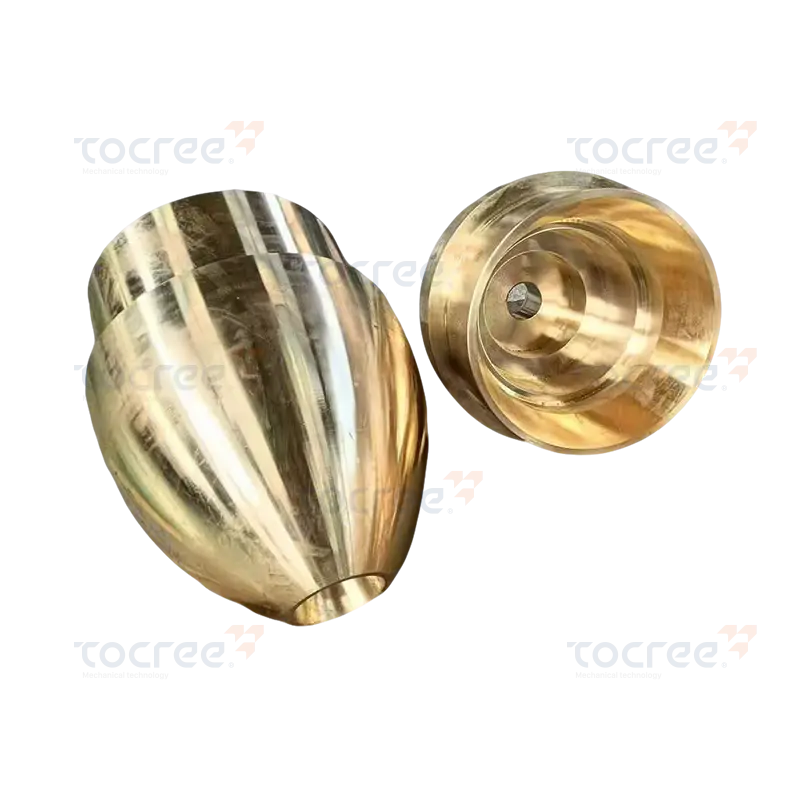 Aluminum Bronze Cylindrical Bushing with Machined Grease GrooveThis straight sleeve combines ZCuAl10Fe3 aluminum bronze with a precision-machined grease groove, offering high strength, thermal conductivity, and impact toughness for heavy-load, oscillating or reversing applications.View Product →
A quick screening calculation is the PV value: pressure multiplied by sliding velocity. Aluminum bronze tolerates high pressure at low speed, but allowable pressure drops quickly as sliding speed increases. An oscillating bearing moving only a few degrees per stroke can run at much higher surface pressure than a continuously rotating journal. Use PV limits supplied by the manufacturer for the specific grade rather than generic printed tables, and confirm them with a bench test if the application is critical.
Look at the real operating conditions, and the applications follow directly:
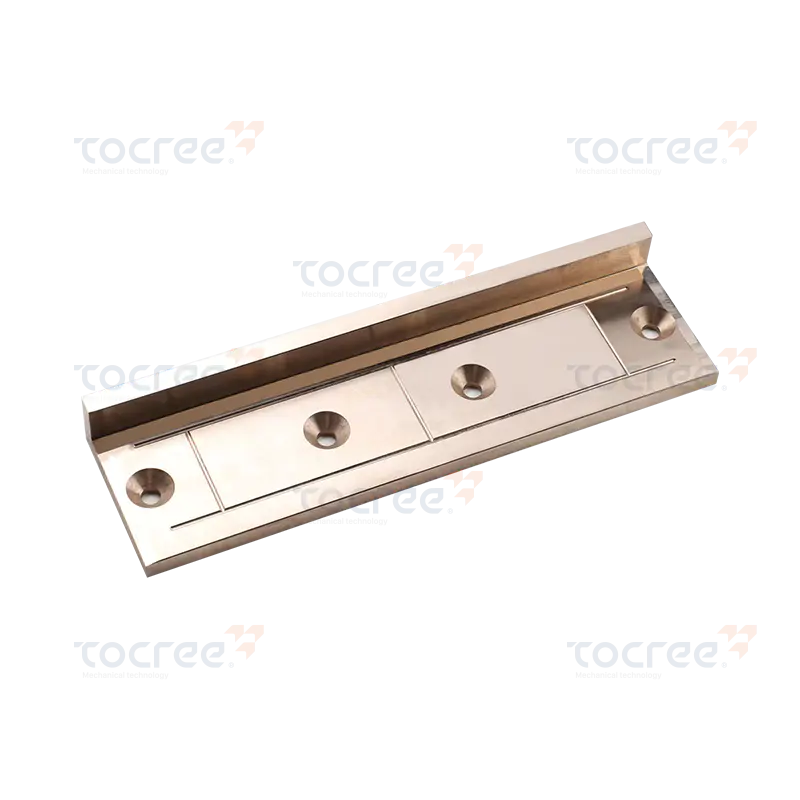
Flat sliding applications use the same aluminum bronze material in the form of bearing pads and slide plates rather than round bushings. When the design calls for flat geometry such as slideways, support pads, or thrust faces, a machined copper bearing pad delivers the same alloy performance in plate form.
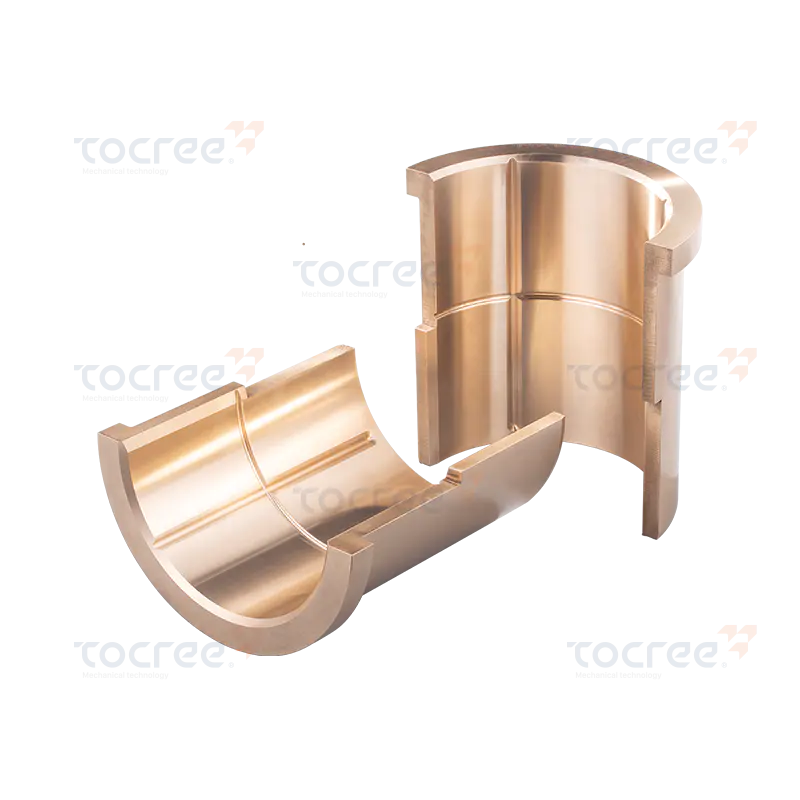 Tin Bronze Copper Bearing Pad for Flat Sliding SurfacesA flat copper bearing pad precision-manufactured from CuSn12 tin bronze, providing wear and corrosion resistance for slideways, support pads, and thrust faces in demanding industrial equipment.View Product →
An aluminum bronze bearing made from the correct alloy still fails early if the casting contains shrinkage or porosity, or if machining leaves a torn surface. Because this material is chosen for severe duty, manufacturing quality usually determines the difference between a six-week bearing and a twelve-month bearing.
A manufacturer that pours its own copper alloys controls chemistry from the very beginning. Jiashan Tocree operates its own melting furnace and centrifugal casting machines, producing roughly 2,300 tons of copper alloy per year. Casting and precision machining under one roof removes the risk of mismatched material certificates, reduces lead time for non-standard shapes, and lets the same engineering team be responsible for both the raw structure and the final tolerance.
The company machines bushing diameters up to 1.5–2 meters and slide plates up to 4 meters long, 400 millimeters wide, and 100 millimeters thick. For large parts, a temperature-controlled workshop and careful toolpath planning are necessary to hold geometric tolerances that would otherwise be impossible to guarantee.
Even for common diameters, the machining discipline is the same. A standard bronze bushing is a good starting point for evaluating bore tolerances, roundness, and surface finish before committing to a completely custom part.
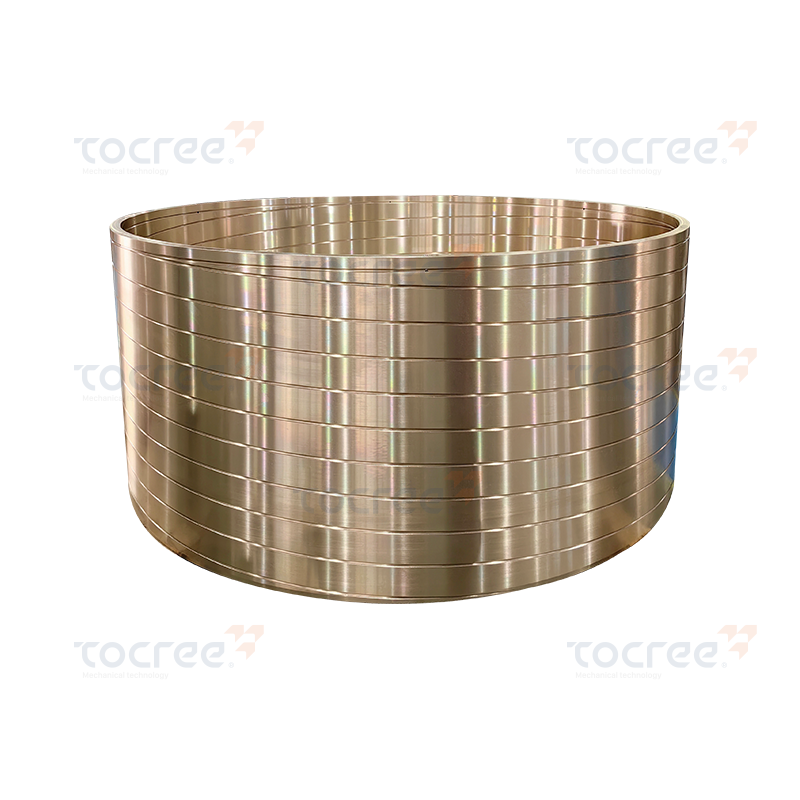 Centrifugally Cast Tin Bronze Bushing with Custom Oil GroovesThis bronze bushing is produced via centrifugal casting with optional inner and outer oil grooves, delivering high tensile strength, hardness, and corrosion resistance for durable bearing performance.View Product →
Some bearing positions simply cannot be re-lubricated: sealed pivot pins, submerged marine fittings, indexing mechanisms, and equipment inside guards or clean rooms. In those cases, a solid self-lubricating variant with graphite or PTFE inserts is worth evaluating. The base material and casting route are the same as for plain aluminum bronze, but solid lubricant pellets are pressed into the wall and release a film during sliding.
Do not expect dry-running PV limits to match a grease-fed aluminum bronze bearing; the numbers are lower, and the choice should be validated against the actual duty. Where relubrication is impossible, the combination of a strong copper-alloy shell and embedded solid lubricant is a practical fallback.
The practical specification for an aluminum bronze sliding bearing is not a single catalog number. It is a load case, an alloy grade, a lubrication plan, and a manufacturer who can execute both casting and machining to the required tolerance. Use aluminum bronze where tin bronze has proven too soft, where water or corrosion is present, or where relubrication is unreliable. Design the oil groove, harden the mating surface, and confirm the PV numbers with the foundry before placing the order. Done correctly, the bearing becomes the last part of the machine you need to worry about.
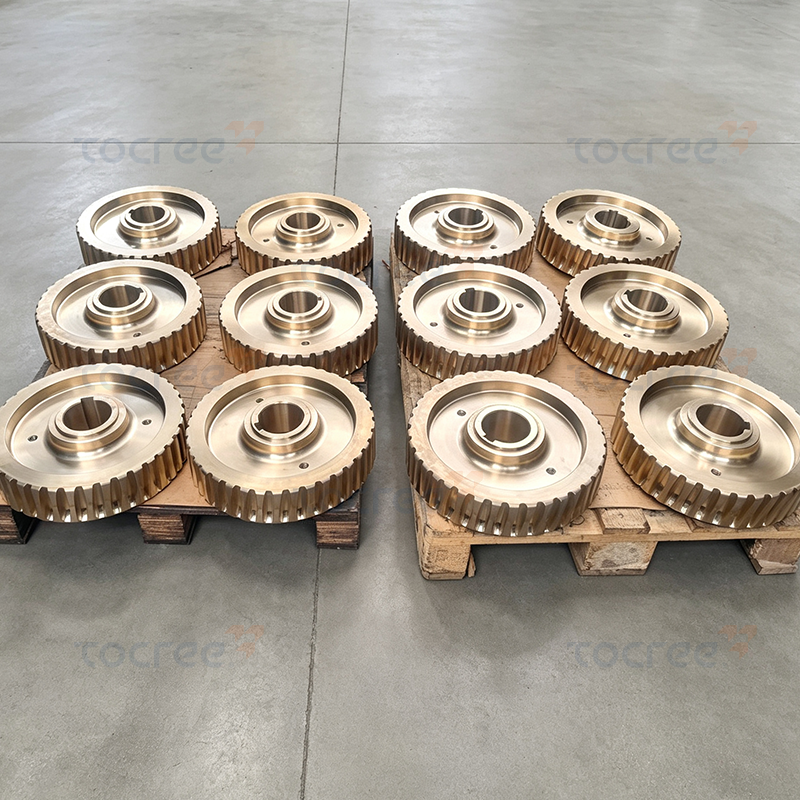
Product Overview This product is an Aluminum Bronze Worm Gear, precision-manufactured from high-stre...
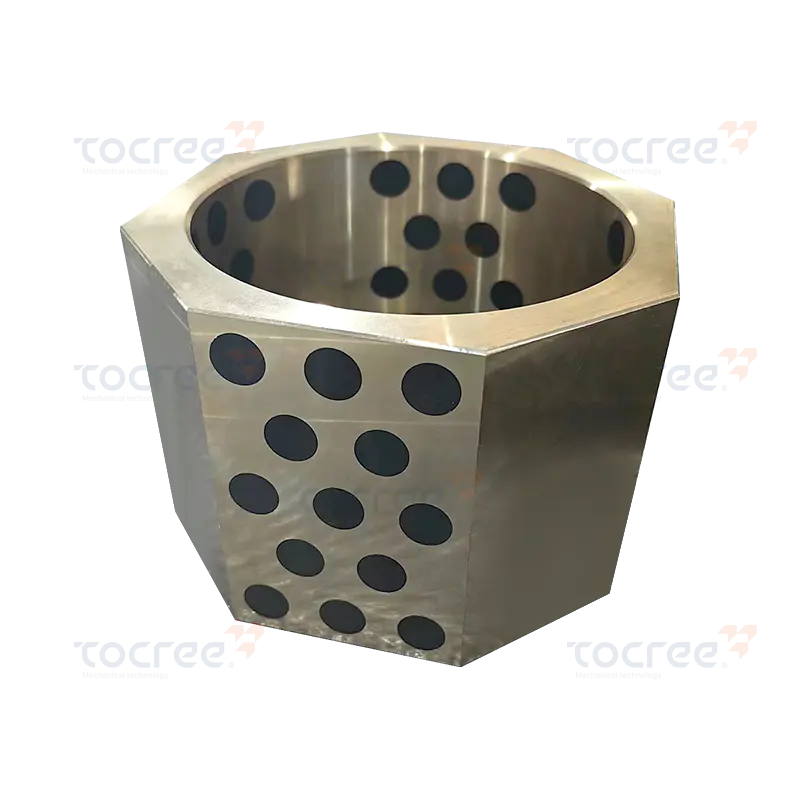
The octagonal bushing made of CuSn6Zn6Pb3 (tin bronze) and graphite precision machining is a self-lu...

This straight sleeve is made of aluminum bronze alloy as the base material. According to customer re...

This bronze sleeve is made of tin bronze as the base material. The blank piece is produced through c...
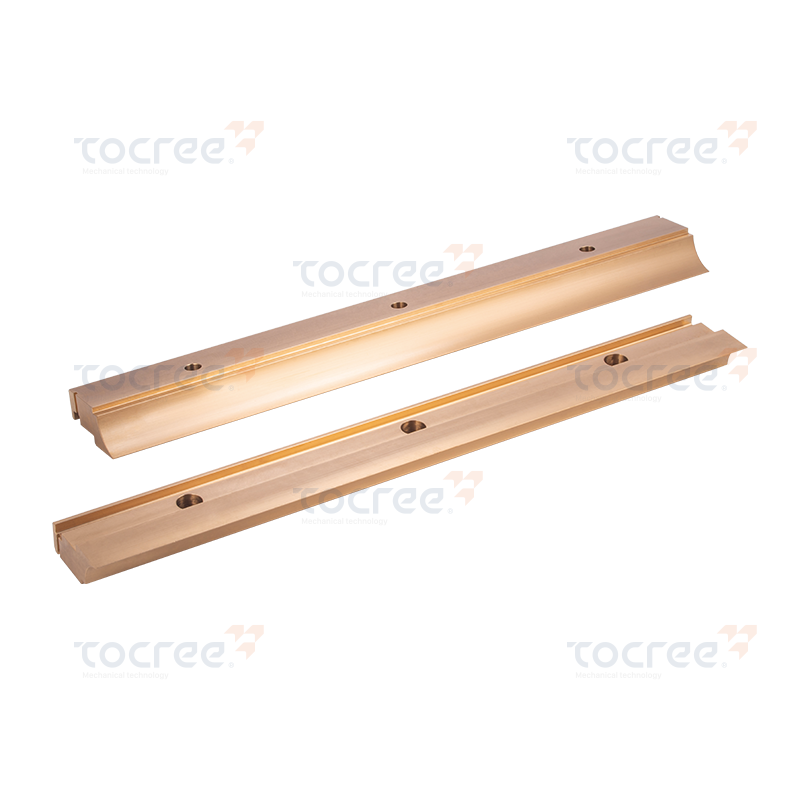
This linear slide board is a high-performance sliding component, made of excellent tin bronze alloy ...
Copyright © 2025 Jiashan Tocree Machinery Co., Ltd. All Rights Reserved.
Customized Copper Alloys Machinery Parts
